Well, here we are... the last days of training! How incredible is that? The days are long here but the weeks have flown by, especially the last few. Swearing-in is at the end of this week, after which we will be honest-to-goodness bonafide Volunteers (complete with capital "V").
Last week we had mini-vacation of sorts, because of Holy Week. Nicaragua is a very Christian country (mostly Catholic), so Semana Santa is a big deal here. There´s no school all week, and Thursday through Sunda almost nothing is open. Lots of people go to the beach -- it´s the middle of summer here, and hot; perfect beach weather if you don´t mind a sunburn -- or vacation somewhere: León and Granada are both popular hot spots.
The evangelical churches here don´t do much to celebrate the occasion, but there are Catholic services every day, usually centering around processions. They start on Palm Sunday with a procession with palms and usually an "imagen" -- a statue -- of Jesus; in our town he was even mounted on a live donkey. The imagen went on a few other walks to different parts of town during the week, but the biggest deal started on Friday. All over Nicaragua people walk the "Via Cruz" in the middle of the day in the blazing sun, sometimes on their knees. That procession usually goes for a few hours, and then on Friday night there´s another procession. In my town, the imagen of Jesus was put in a glass coffin lit up -- they processed around town with it like that from about eight at night to more or less one am, accompanied by a marching band playing mournful music at top volume (because no Nicaraguan procession is complete without a marching band).
Saturday night there was a mass here for Easter Vigil, and another service on Easter Sunday itself, but they were very low-key after Friday´s excitement.
Another common thing here during Semana Santa is giving food -- we have literally a bucket of rosquillas sitting on our kitchen table which people have given us. Delicious!
There are lots of other cool things here during Semana Santa -- for example, in León they make all sorts of beautiful pictures out of sand on the streets, and when they´re finished, everyone processes over them. Maybe next year I´ll visit see it first hand.
First things first, though. Swearing-in, here I come!
Showing posts with label training. Show all posts
Showing posts with label training. Show all posts
Tuesday, April 6, 2010

Wednesday, March 31, 2010
Day 68
I’ve had more or less 68 days in country so far, if my math is right, so I guess I was probably past due for a Creepy Bug Encounter. Usually they happen in the first week or so, and you get your Bug Scream down pat and go on with your life; I thought I might be immune, but apparently I am just behind the curve.
I am not usually all that bothered by insects; it helps that there aren’t any poisonous or even really large bugs where I live. Mosquitoes are annoying, and I could live without black flies and june bugs or those beetles that invade gardens to munch on plants and have orange guts when you squash them, but overall Mother Nature and I coexist pretty contentedly.
During my site visit, on one of the days that I spent in the health center, someone from one of the outlying communities brought in an enormous chagas bug in a plastic bag, and that gave me pause. (We all live in utter fear of chagas disease thanks to the horror stories people love to tell about it – look it up and you’ll probably see why. It is like an invisible stalker of a disease that hangs out until you can’t even remember where you might have gotten it and then totally destroys your life; no thanks.) I made sure to ask the woman who had the bug where she was from, how far she lived from my town, and why she was wandering around with a chagas bug just chilling in a bag. (MINSA requires people to bring in chagas bugs when they find them in their houses, so they can record where they’re found; smart thinking. My next mission is to find the chart they record the information on and see where I am safe.)
So I handled the chagas bug pretty coolly and made sure my mosquito net was tucked in as tightly as it possibly could be at night and thought I was pretty safe.
But the bugs wait, and while they wait they have little buggy conferences about how best to take advantage of your smug complacency. And then this morning they struck.
It always seems like they find you in the bathroom in whatever Horrific Bug Story someone tells; there’s something about coming face to face with an enormous bug with beady eyes when you are barefoot and have only a travel towel with which to defend yourself that makes the whole experience a hundred times more terrifying. There I am, picking up my shampoo, and all of a sudden a cockroach launches itself at me out of nowhere, screaming its little war cry as it waves all of its legs around and scuttles toward me as menacingly as it could.
That made me jump, but I recovered well and dove for the bucket of water with the vague notion of washing it out the hole in the wall that serves as a drain, and something else brushed my hand. I looked down, and there was a spider literally bigger than my hand glaring at me with all eight eyes and looking even madder than spiders usually do.
I screamed. I’ll admit it. I don’t have a very impressive Bug Scream, nothing like the bloodcurdling, earsplitting ones you hear in movies when there’s someone on top of a chair with mice running around below, but it was loud enough for my purposes. I hit the cockroach with my bottle of shampoo, which only stunned it for a moment before it disappeared into the shadows somewhere, the way cockroaches always seem to do. Then the spider and I sat there for few minutes in a stand-off, watching each other.
“I need that bucket,” I pointed out, but it was unimpressed. Spiders are obnoxiously reticent at the best of times, and this one was mad at me to boot.
“Spider,” I said, “look, I respect your right to inhabit this bathroom, fine, but I have soap in my eyes and it is too early to deal with stubborn arachnids.”
No response. I finally ended up sort of gingerly splashing it with a little water, and it sidled away to lurk in the curtain, glowering balefully down at me the whole time, which made me entirely uneasy. I kept twitching my head around to keep an eye on it, half-afraid it might leap at me like the cockroach. I read the book Arachnophobia as a kid, and of course the only bits that stuck with me are the parts where the protagonists are shooting at enormous spiders with nail guns and the things just keep coming – this is not really a good thing for your peace of mind, especially as it is singularly disconcerting to be glared at by a spider to begin with.
My host mother found and killed it this afternoon, in case anyone with a horror of spiders should need to use our bathroom, but not before telling me that this spider is not actually large. “Oh no,” she told me; “this is just a little one.”
I’m definitely going to have to work on my Bug Scream.
I am not usually all that bothered by insects; it helps that there aren’t any poisonous or even really large bugs where I live. Mosquitoes are annoying, and I could live without black flies and june bugs or those beetles that invade gardens to munch on plants and have orange guts when you squash them, but overall Mother Nature and I coexist pretty contentedly.
During my site visit, on one of the days that I spent in the health center, someone from one of the outlying communities brought in an enormous chagas bug in a plastic bag, and that gave me pause. (We all live in utter fear of chagas disease thanks to the horror stories people love to tell about it – look it up and you’ll probably see why. It is like an invisible stalker of a disease that hangs out until you can’t even remember where you might have gotten it and then totally destroys your life; no thanks.) I made sure to ask the woman who had the bug where she was from, how far she lived from my town, and why she was wandering around with a chagas bug just chilling in a bag. (MINSA requires people to bring in chagas bugs when they find them in their houses, so they can record where they’re found; smart thinking. My next mission is to find the chart they record the information on and see where I am safe.)
So I handled the chagas bug pretty coolly and made sure my mosquito net was tucked in as tightly as it possibly could be at night and thought I was pretty safe.
But the bugs wait, and while they wait they have little buggy conferences about how best to take advantage of your smug complacency. And then this morning they struck.
It always seems like they find you in the bathroom in whatever Horrific Bug Story someone tells; there’s something about coming face to face with an enormous bug with beady eyes when you are barefoot and have only a travel towel with which to defend yourself that makes the whole experience a hundred times more terrifying. There I am, picking up my shampoo, and all of a sudden a cockroach launches itself at me out of nowhere, screaming its little war cry as it waves all of its legs around and scuttles toward me as menacingly as it could.
That made me jump, but I recovered well and dove for the bucket of water with the vague notion of washing it out the hole in the wall that serves as a drain, and something else brushed my hand. I looked down, and there was a spider literally bigger than my hand glaring at me with all eight eyes and looking even madder than spiders usually do.
I screamed. I’ll admit it. I don’t have a very impressive Bug Scream, nothing like the bloodcurdling, earsplitting ones you hear in movies when there’s someone on top of a chair with mice running around below, but it was loud enough for my purposes. I hit the cockroach with my bottle of shampoo, which only stunned it for a moment before it disappeared into the shadows somewhere, the way cockroaches always seem to do. Then the spider and I sat there for few minutes in a stand-off, watching each other.
“I need that bucket,” I pointed out, but it was unimpressed. Spiders are obnoxiously reticent at the best of times, and this one was mad at me to boot.
“Spider,” I said, “look, I respect your right to inhabit this bathroom, fine, but I have soap in my eyes and it is too early to deal with stubborn arachnids.”
No response. I finally ended up sort of gingerly splashing it with a little water, and it sidled away to lurk in the curtain, glowering balefully down at me the whole time, which made me entirely uneasy. I kept twitching my head around to keep an eye on it, half-afraid it might leap at me like the cockroach. I read the book Arachnophobia as a kid, and of course the only bits that stuck with me are the parts where the protagonists are shooting at enormous spiders with nail guns and the things just keep coming – this is not really a good thing for your peace of mind, especially as it is singularly disconcerting to be glared at by a spider to begin with.
My host mother found and killed it this afternoon, in case anyone with a horror of spiders should need to use our bathroom, but not before telling me that this spider is not actually large. “Oh no,” she told me; “this is just a little one.”
I’m definitely going to have to work on my Bug Scream.
Saturday, March 27, 2010
news from Honduras... I mean, Nicaragua
Here I am back again from my week-long site visit, and the bowl of fruit I had this morning for breakfast was the most delicious thing I have eaten in what feels like a long, long time. But let me start at the beginning...
My new home is tucked away in the mountains in the very north of Nicaragua, very nearly in Honduras. (We watched Honduran television the whole time I was there -- I've now become invested in a Honduran soap opera called “Doña Barbara” which is overly dramatic and therefore hilarious, as every good fotonovela should be.) It’s a tiny town, with two main streets running parallel to each other and not much else except the school and health center.

(The main drag)

(The health center)
It’s also small enough that I now know probably 80% of the kids’ names, mostly because they came looking for me and we played fútbol in the middle of the street every night I was there -- lots of fun!

(New friends!)
The area is a pretty arid part of Nicaragua to begin with, and last year there wasn’t much in the way of rain during the winter (which is May-October, which is really throwing me off), so as of right now, the hottest part of the year, it’s all dry as a bone and incredibly dusty.
 <
<
(Everything is dry dry dry... and dusty)

(The views are pretty awesome though)

(The local river... good for everything from bathing to washing clothes)
Through some kind of combination of the local climate and local customs, people here hardly ever eat vegetables. Ever. Really. For every meal (and I mean every meal) at my new house, I ate rice and beans and tortillas in some kind of combination, with occasional boiled potatoes, fried plantains, french fries, or fried eggs to mix it up a little bit. So coming back to my training family, who is weirdly into fresh vegetables for a Nicaraguan family, has been a wonderful thing. (Plus we have an indoor toilet, even if we don’t have running water -- what a luxury!)
Between the poverty level and being unaccustomed to eating fruits and veggies, malnutrition is a pretty rampant problem in my area, so I think that’s something I’ll be working with quite a bit in terms of health education and trying out ways to make things more available, starting at the health center’s little store, which only sells junk food. There’s also a lot of work to be done with teenagers, mostly with preventing teen pregnancy. I met a pregnant 13-year-old and a 17-year-old who was pregnant with her second kid -- there are so many factors tying into the high teenage pregnancy rate here in Nicaragua (these kids’ stories are not uncommon), but that’s definitely one of the things I’ll be working on.
For now, though, it’s back to classes for another two weeks, and the final set of language and technical interviews to make sure we all meet the requirements for swearing in. Time flies so fast; it’s unbelievable!
My new home is tucked away in the mountains in the very north of Nicaragua, very nearly in Honduras. (We watched Honduran television the whole time I was there -- I've now become invested in a Honduran soap opera called “Doña Barbara” which is overly dramatic and therefore hilarious, as every good fotonovela should be.) It’s a tiny town, with two main streets running parallel to each other and not much else except the school and health center.

(The main drag)

(The health center)
It’s also small enough that I now know probably 80% of the kids’ names, mostly because they came looking for me and we played fútbol in the middle of the street every night I was there -- lots of fun!

(New friends!)
The area is a pretty arid part of Nicaragua to begin with, and last year there wasn’t much in the way of rain during the winter (which is May-October, which is really throwing me off), so as of right now, the hottest part of the year, it’s all dry as a bone and incredibly dusty.
 <
<(Everything is dry dry dry... and dusty)
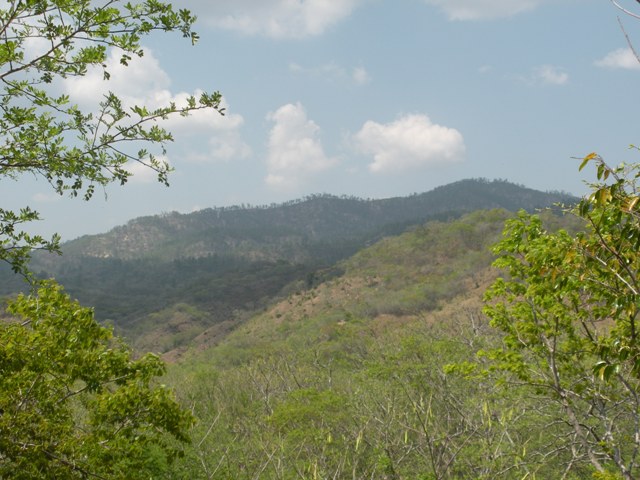
(The views are pretty awesome though)
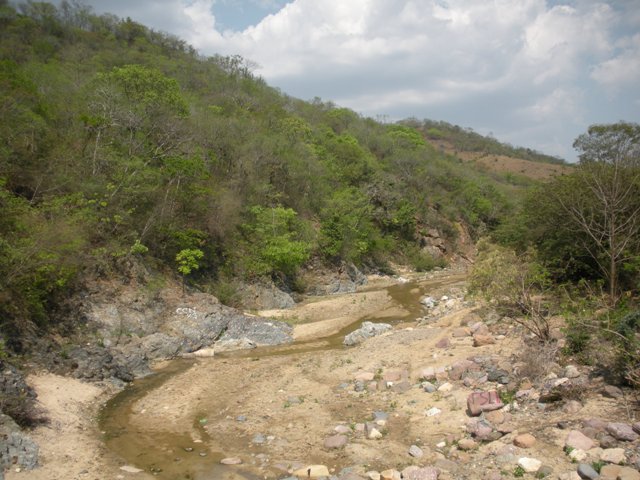
(The local river... good for everything from bathing to washing clothes)
Through some kind of combination of the local climate and local customs, people here hardly ever eat vegetables. Ever. Really. For every meal (and I mean every meal) at my new house, I ate rice and beans and tortillas in some kind of combination, with occasional boiled potatoes, fried plantains, french fries, or fried eggs to mix it up a little bit. So coming back to my training family, who is weirdly into fresh vegetables for a Nicaraguan family, has been a wonderful thing. (Plus we have an indoor toilet, even if we don’t have running water -- what a luxury!)
Between the poverty level and being unaccustomed to eating fruits and veggies, malnutrition is a pretty rampant problem in my area, so I think that’s something I’ll be working with quite a bit in terms of health education and trying out ways to make things more available, starting at the health center’s little store, which only sells junk food. There’s also a lot of work to be done with teenagers, mostly with preventing teen pregnancy. I met a pregnant 13-year-old and a 17-year-old who was pregnant with her second kid -- there are so many factors tying into the high teenage pregnancy rate here in Nicaragua (these kids’ stories are not uncommon), but that’s definitely one of the things I’ll be working on.
For now, though, it’s back to classes for another two weeks, and the final set of language and technical interviews to make sure we all meet the requirements for swearing in. Time flies so fast; it’s unbelievable!
Wednesday, March 17, 2010
location, location, location
I have no pre-typed report to give you all today, so this is going to be much shorter than usual!
Our trip to Chinandega went really well; lots of practicing Spanish and learning about HIV/AIDS and its presence in Nicaragua. We gave charlas in health centers and schools and fire stations and naval bases between the 24 of us, all in one day, but wasn´t all serious -- we had some fun, too! We played one game called "birdie on the perch" our last morning in Chinandega:

And I had my first dip in the Pacific Ocean, which was beautiful:

And while I´m uploading photos, here are a few old ones from our trip to the volcano in Masaya:


BUT THE MOST EXCITING THING I have to say is not any of these things. The most exciting thing I have to say is that I received my site! For the next two years, I´ll be living and working in a little town in Nueva Segovia, the northernmost department of Nicaragua. I´ll actually be so close to Honduras that my info packet tells me that in many ways my site is more like Honduras than Nicaragua! I´m super excited about it, though -- I´ll be far from Managua but in the beautiful mountains where it´s cooler than in other parts of Nicaragua.
I leave in a few days to spend a week getting to know my site and meet my host family and work counterpart; I should have lots of stories when I get back!
Our trip to Chinandega went really well; lots of practicing Spanish and learning about HIV/AIDS and its presence in Nicaragua. We gave charlas in health centers and schools and fire stations and naval bases between the 24 of us, all in one day, but wasn´t all serious -- we had some fun, too! We played one game called "birdie on the perch" our last morning in Chinandega:

And I had my first dip in the Pacific Ocean, which was beautiful:

And while I´m uploading photos, here are a few old ones from our trip to the volcano in Masaya:


BUT THE MOST EXCITING THING I have to say is not any of these things. The most exciting thing I have to say is that I received my site! For the next two years, I´ll be living and working in a little town in Nueva Segovia, the northernmost department of Nicaragua. I´ll actually be so close to Honduras that my info packet tells me that in many ways my site is more like Honduras than Nicaragua! I´m super excited about it, though -- I´ll be far from Managua but in the beautiful mountains where it´s cooler than in other parts of Nicaragua.
I leave in a few days to spend a week getting to know my site and meet my host family and work counterpart; I should have lots of stories when I get back!
Sunday, March 7, 2010
(No pictures again today since I spaced out about them and didn´t put them on my flash drive. Next time!)
So it’s been a while! There’s lots to catch you up on. We’re over halfway through with training, and the pace has definitely picked up; if it was busy before, it’s twice as busy now, what with youth group meetings (and getting the youth group to prepare their own charla to give in public), designing and giving a health survey in our communities, traveling to different parts of Nicaragua, more charlas in the health center and schools, and trying (and failing) not to worry about our site placements.
My visit to the mountains of Jinotega was relatively uneventful, except for missing my bus stop in Estelí and having to hike back along the carretera to where I was supposed to catch my next bus -- travel here is a little more difficult since no one announces the bus stops and more often than not there aren’t any signs marking them. But I made it to the site in the end, after about four hours on relatively even, paved roads and two on a narrow dirt road winding into the mountains. Our bus went extraordinarily gingerly, which was gratifying and nervewracking all at once: there is a joke here that school buses from the US go to Guatemala to die, and after they die in Guatemala they’re sent here.
Other than one flat tire the bus ride wasn’t actually that bad, except for the dust (and the fact that my legs didn’t fit in a school bus seat when I was still riding them to school, let alone now). We’re going into the hottest part of the dry summer season now, so everything is brown and the dust is pretty thick.
The site I visited was a quiet little town tucked away in a valley with lots of coffee and bananas, and not much to do except walk around and talk to people, which I did a lot of with the volunteer I visited. We went to the health center and the local casa materna (there is a whole network of these houses slowly being built up in Nicaragua for pregnant women to stay in during their last two weeks of pregnancy, in an effort to promote institutional births and thereby cut the rate of maternal and infant mortality) and to the school, but mostly we had conversations -- with a biologist who works for the municipal government, with street vendors and pulperia owners; with anyone, really, who wanted to talk to us. Nicaraguans in general are incredibly friendly people; they invite you into their homes and feed you whatever’s on hand, which in the north is usually tortillas, cuajada (a soft, salty cheese), and the ever-present gallo pinto and coffee or fruit juice which is generally one part coffee or juice and three parts sugar. My teeth ache a little just thinking about it.
The week we returned to our training towns, we went to Masaya to have our site fair and to visit the old market and the volcano Masaya is famous for. We now have a packet and basic information on the sites we’ll be sent to after swearing-in, which has upped my nerves exponentially, and we got to see a little more of Nicaragua, which is always welcome. We didn’t end up seeing much of the market, but the volcano was beautiful in a very stark sort of way. Pictures can’t really capture the size of it, or the feeling you get driving up to it over rolling hills where there’s nothing but black volcanic rock and red earth. (It doesn’t capture the sulfur smell, either -- we could only spend twenty minutes on the top of the volcano trying to look through the smoke into the crater, since Vulcán Masaya is still active and belches out quite a bit of gas.)
This past week we’ve been busy with a second round of language interviews to measure our progress -- we have to reach an intermediate level to qualify for service as a volunteer -- and with the normal ins and outs of daily language classes, youth group meetings, and charlas in the health center. Thursday was especially busy: I gave a 16-minute charla on hygiene in front of 19 people I’d never met before who were able to understand me, followed by language class and interviews, followed by an hour and a half long charla on the reproductive systems with our youth group in which we made the boys race against the girls to identify the organs and their functions -- things I never could have even hoped to do two months ago. And yesterday we traveled back up into the mountains as a group, this time to Matagalpa to visit a couple who are ending their service in a few weeks time so we could see the work they’ve done in the casa materna there. The bus ride was just this side of being excruciatingly long (we left at 5:30am and didn’t get back until 7:30pm) but it was fun to be all together as a training group, and interesting to see another site in action.
It’ll be good training, too, for next week, when we travel to Chinandega for four days to learn about and work with HIV/AIDS prevention. Chinandega shares a border with Honduras, which has a high rate of HIV/AIDS for this region, and Chinandega has one of the highest rates of HIV in Nicaragua, so there’s lots of work to be done there in terms of education and prevention. Chinandega also happens to be the hottest part of Nicaragua, and we are going during the hottest part of the year, so we may all melt, but if not I’ll be back next weekend with pictures from our trip and about twice the level of nervous excitement I have now -- our site placement is next Monday (which is, incidentally, the Ides of March... hopefully the day will go better for us than it did for Caesar!).
So it’s been a while! There’s lots to catch you up on. We’re over halfway through with training, and the pace has definitely picked up; if it was busy before, it’s twice as busy now, what with youth group meetings (and getting the youth group to prepare their own charla to give in public), designing and giving a health survey in our communities, traveling to different parts of Nicaragua, more charlas in the health center and schools, and trying (and failing) not to worry about our site placements.
My visit to the mountains of Jinotega was relatively uneventful, except for missing my bus stop in Estelí and having to hike back along the carretera to where I was supposed to catch my next bus -- travel here is a little more difficult since no one announces the bus stops and more often than not there aren’t any signs marking them. But I made it to the site in the end, after about four hours on relatively even, paved roads and two on a narrow dirt road winding into the mountains. Our bus went extraordinarily gingerly, which was gratifying and nervewracking all at once: there is a joke here that school buses from the US go to Guatemala to die, and after they die in Guatemala they’re sent here.
Other than one flat tire the bus ride wasn’t actually that bad, except for the dust (and the fact that my legs didn’t fit in a school bus seat when I was still riding them to school, let alone now). We’re going into the hottest part of the dry summer season now, so everything is brown and the dust is pretty thick.
The site I visited was a quiet little town tucked away in a valley with lots of coffee and bananas, and not much to do except walk around and talk to people, which I did a lot of with the volunteer I visited. We went to the health center and the local casa materna (there is a whole network of these houses slowly being built up in Nicaragua for pregnant women to stay in during their last two weeks of pregnancy, in an effort to promote institutional births and thereby cut the rate of maternal and infant mortality) and to the school, but mostly we had conversations -- with a biologist who works for the municipal government, with street vendors and pulperia owners; with anyone, really, who wanted to talk to us. Nicaraguans in general are incredibly friendly people; they invite you into their homes and feed you whatever’s on hand, which in the north is usually tortillas, cuajada (a soft, salty cheese), and the ever-present gallo pinto and coffee or fruit juice which is generally one part coffee or juice and three parts sugar. My teeth ache a little just thinking about it.
The week we returned to our training towns, we went to Masaya to have our site fair and to visit the old market and the volcano Masaya is famous for. We now have a packet and basic information on the sites we’ll be sent to after swearing-in, which has upped my nerves exponentially, and we got to see a little more of Nicaragua, which is always welcome. We didn’t end up seeing much of the market, but the volcano was beautiful in a very stark sort of way. Pictures can’t really capture the size of it, or the feeling you get driving up to it over rolling hills where there’s nothing but black volcanic rock and red earth. (It doesn’t capture the sulfur smell, either -- we could only spend twenty minutes on the top of the volcano trying to look through the smoke into the crater, since Vulcán Masaya is still active and belches out quite a bit of gas.)
This past week we’ve been busy with a second round of language interviews to measure our progress -- we have to reach an intermediate level to qualify for service as a volunteer -- and with the normal ins and outs of daily language classes, youth group meetings, and charlas in the health center. Thursday was especially busy: I gave a 16-minute charla on hygiene in front of 19 people I’d never met before who were able to understand me, followed by language class and interviews, followed by an hour and a half long charla on the reproductive systems with our youth group in which we made the boys race against the girls to identify the organs and their functions -- things I never could have even hoped to do two months ago. And yesterday we traveled back up into the mountains as a group, this time to Matagalpa to visit a couple who are ending their service in a few weeks time so we could see the work they’ve done in the casa materna there. The bus ride was just this side of being excruciatingly long (we left at 5:30am and didn’t get back until 7:30pm) but it was fun to be all together as a training group, and interesting to see another site in action.
It’ll be good training, too, for next week, when we travel to Chinandega for four days to learn about and work with HIV/AIDS prevention. Chinandega shares a border with Honduras, which has a high rate of HIV/AIDS for this region, and Chinandega has one of the highest rates of HIV in Nicaragua, so there’s lots of work to be done there in terms of education and prevention. Chinandega also happens to be the hottest part of Nicaragua, and we are going during the hottest part of the year, so we may all melt, but if not I’ll be back next weekend with pictures from our trip and about twice the level of nervous excitement I have now -- our site placement is next Monday (which is, incidentally, the Ides of March... hopefully the day will go better for us than it did for Caesar!).
Wednesday, February 10, 2010
Another week come and gone already – I’m writing this on Tuesday, which means today marks three weeks since I flew into DC for staging. It seems like it’s been so much longer than that, though the last week has absolutely flown by.
We have a lot more to do now; the first week and a half or so was almost purely basic survival Spanish, at least for us in the lower level of language ability, and adjusting to the total culture shock. Now that we’re a little more familiar with the area and the language, we suddenly have a hundred things to do...
We’ve met two or three times now with the youth group we’ve formed: so far we haven’t done much except talk and play games, but next week we start giving our first “charlas”, or talks – one with the group and one in the local health center. Intimidating with the language barrier still very much in force, although it’s getting easier to understand other people, at least. Speaking is still stop-and-go to some extent – vocabulary is an incredibly, frustratingly stubborn obstacle – and I am definitely ready to stop sounding like a three-year-old. Sigh. We’re also starting to formulate the survey we’ll be carrying out in our training town: we’ve decided to interview people about myths and knowledge about HIV/AIDS, since the HIV rate in our municipality is worryingly high for the size of the population. We won’t be conducting the survey for a few more weeks, but wish us luck!
One of the strangest things has been catching glimpses of American culture here. Lady Gaga’s “Poker Face” keeps playing over TV advertisements for a local beauty pageant. There’s a Quiznos, a Subway, and a Sbarro in the mall in Managua – a mall that’s nicer by far than the nearest mall to my hometown. Today I watched “Invictus” courtesy of my host father and the thriving pirated DVD trade here... but with Spanish subtitles only, since something went weird with the sound and left only the background noise, with no speaking voices.
More adventures in food to report as well: pupusas, (the perfect finger food), which are a little bit like quesadillas with thicker, doughier ‘crust’ and usually cheese and frijoles molidas (think of a sort of thick bean sauce – a little thinner than refried beans,) in the middle, and as of today, pan dulce, which is exactly what it probably sounds like: basically a big crunchy bread thing coated in sugar. A little like fried dough, but less greasy. One other thing was a failure on the taste-front: a drink I think is called “chicha” or something similar, apparently very popular and traditional here. It’s made from maize and tastes a little bit like paste. I can’t decide if the tradition of coloring it bright, lurid pink makes it better or worse.
Irregular verbs in the preterite are on the agenda for tomorrow, along with planning our first charlas and heading to one of the local Ministry of Health offices for a technical seminar. I have finally unpacked my camera, as well, so hopefully I’ll have some pictures to put up here soon!
PS: I just found out that the fiesta patronal for my town begins this weekend -- 8 days of celebrating the town and its patron saint (Nuestra Madre de La Paz -- Our Lady of Peace) with traditional food, fireworks, and dancing! Should be very exciting; one of the famous dances that happens at a lot of these fiestas patronales is actually recognized as a World Heritage tradition. I´ll let you all know how it turns out!
Friday, February 5, 2010
welcome!
Welcome to Notes from Nica, a blog about my life as a Peace Corps trainee in Nicaragua! Two weeks into training here, and as so much has already happened and I’m always terrible at starting things like this anyway, I’ll get things going with something simple: lists! Everyone loves a list, right?
LIKES:
- My host family and my training town. Pretty lucky for me! I live in a small town about an hour away from Managua, the capital city, where nearly everyone I meet is related to me through my host family. It’s a new experience to live in a place where people leave their doors open all the time, where they smile and wave and stop you in the street to chat, where kids and aunts and brother-in-laws are in and out of each others’ houses all the time. There’s a pulperia (a sort of Nicaraguan convenience store) and a public telephone in my front hall here, so there are always people in and out to talk to; a great way to meet more people in the community.
- The food in Nicaragua. There are very few foods I refuse to touch, and usually they involve fungus. I have to say, though, that Nicaraguans really know my weak spots. Beans and rice? Check: the favorite food here is gallo pinto, rice and beans cooked together with spices. Fresh fruit and veggies? Check: so far I have indulged in watermelon, oranges, mandarins, pineapple, avocados, limes, bananas, plantains and more, all a hundred times fresher than I ever got in the States. Eggs? Check, especially scrambled and in combination with potatoes. There isn’t as much meat here, which is a change, but instead there are things like rosquillas, baked crunchy tart-like things made from maize which are particularly popular during Holy Week, when they’re made into empanadas with a little bit of cheese and sugar inside. Delicious!
- My fellow trainees. There are something like 24 of us in our training class, and it’s been glorious to live and work with such a group of fun, positive people. I know there are probably going to be days when we want nothing more than to leave and go back home, when we won’t be able to stand each other, Nicaragua, our work, or ourselves, but starting with such a wonderfully upbeat group has got to count in our favor. Everyone has so far been very laid back and easygoing, and has brought their own kind of passion to the work we’re doing here; it’s so interesting to talk to everyone about the kind of work they’ve done in the past, and what they’re hoping to do in Nicaragua. I’m definitely looking forward to seeing what kinds of creative things they start here.
CHANGES, because I don’t actually have a dislike list:
- The bus system. Nothing runs on a schedule or anything like one. We mostly rely on a network of microbuses, hopping on and off from bus “stations” which are sometimes nothing more than street corners, or just hailing the driver or “cobrador”, who sits with the passengers and takes the fares. Add to that the fact that there are no street names here – just directions like “one block north and two blocks east from the bank” (or from the site of an important event – even more difficult!) and traveling is always an adventure.
- Bucket showers. My house has indoor plumbing, but the water here doesn’t run all day – some days it only runs for a couple hours at about 4am. We fill a tank in the back yard and haul buckets from that all day to shower, flush the toilet, do the dishes, and wash our hands. I use a lot less water here, now that it’s more difficult to get than just turning on a tap! Added to that I’m going to throw in the lack of resources we take for granted in the States, particularly internet. I was so dependent on my wireless internet before I came here, and now the nearest internet café is a 20 minute bus ride away. Definitely a tough adjustment to make.
- Language. Obviously I knew I’d be living and working and breathing in another language, but it’s beyond frustrating to have things to say and be unable to communicate them. Adding to that the fact that existing in another language is seriously mentally exhausting, it’s no wonder I sleep incredibly well here (and have already breezed my way through three of the English books I brought with me, just to have a little bit of English in my day!). Slowly but surely, poco a poco; that’s my motto – it’ll come in time. Already I am light years ahead of where I was when I flew into Managua, and it’s only been two weeks!
That’s all I have for now; I’ll try to update this at least semi-regularly with new and hopefully exciting things, but we’ll see how it goes.
Adios for now, amigos!
Subscribe to:
Posts (Atom)